# Harvard Affiliates
##
expand\_more
As a Harvard Affiliate, you have access to a large number of support services when sharing your research data in the Harvard Dataverse Repository. If you are sharing data as part of an NIH grant, please see our [support documentation](https://support.dataverse.harvard.edu/nih-grei) and the [NIH-DMSP guidance](https://support.dataverse.harvard.edu/harvard-dataverse-nih-dmp-guidance) document.
The [Harvard Library](https://library.harvard.edu/services-tools/teach-library) and the [Harvard Dataverse Repository](https://support.dataverse.harvard.edu/calendar/upcoming) offer training throughout the year to support your data-sharing needs.
If you are ready to start sharing your data on the repository, start by [creating a collection](https://dataverse.harvard.edu/)!
#### Support for Harvard Affiliates, at a Glance!
**Enhanced data sharing services for Harvard users include:**
- Up to 2.5 TB of free storage of computationally reusable research data in the repository, on AWS
- Store large data at reduced costs (more than 2.5 TB) via the [Dataverse - Globus](https://support.dataverse.harvard.edu/large-data-support) integration
- [OnDemand-Loop](https://iqss.github.io/ondemand-loop/), *Harvard Only*
- Extended free consultation hours
- Support letters for research grant applications, explaining how the repository can support your final data products
- Extended consultation on data de-identification and data use agreements, and best practices in data sharing
- Department-level demos, training, and assistance with getting your collection started.
[Contact our office](mailto:support@dataverse.org) if you require these services.
**Note:** The repository uses a “Submit for Review” workflow solely for spam mitigation. A member of Harvard Dataverse staff will publish submissions within 24 hours during regular business hours (Monday - Friday).
Sort\*Examples of Harvard-affiliated Journals, faculty, and departments sharing data on the Harvard Repository[ 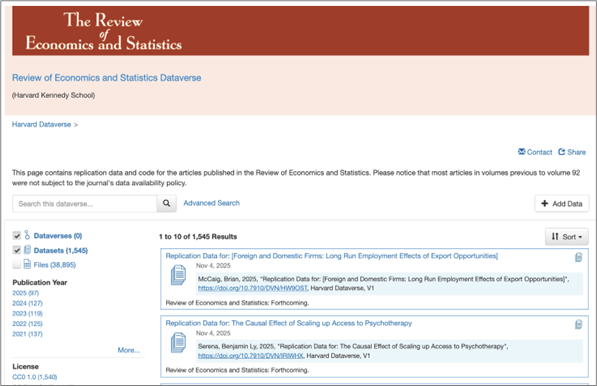
](https://dataverse.harvard.edu/dataverse/restat)[ 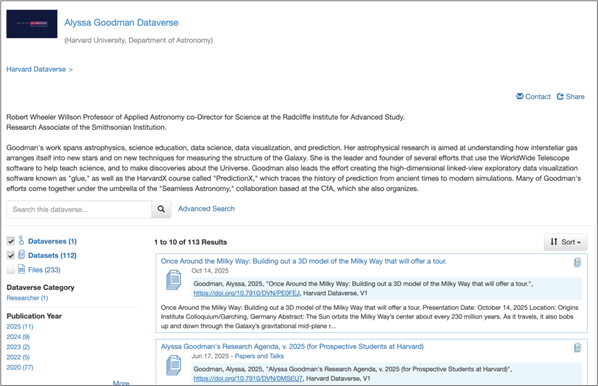
](https://dataverse.harvard.edu/dataverse/AGoodman)[ 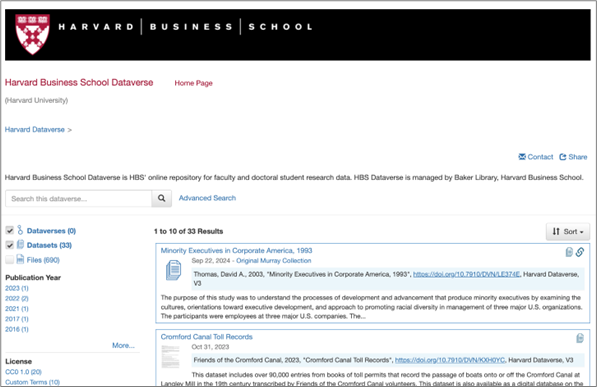
](https://dataverse.harvard.edu/dataverse/hbs)
#### **Features the Harvard Dataverse Repository supports:**
- [Customizable collections](https://guides.dataverse.org/en/latest/user/dataverse-management.html) with a shareable URL
- [Dataset](https://guides.dataverse.org/en/latest/admin/dataverses-datasets.html) with both dataset and file level DOIs (the latter by request)
- Anonymous peer review and [Preview URL ](https://guides.dataverse.org/en/latest/user/dataset-management.html#preview-url-to-review-unpublished-dataset)functionality
- Metadata exports in several formats, including [Croissant](https://github.com/gdcc/exporter-croissant) for machine learning & AI datasets
- Dataverse [APIs](https://guides.dataverse.org/en/latest/api/index.html)
- Multiple [roles and permissions](https://guides.dataverse.org/en/latest/user/dataverse-management.html#roles-permissions) for collection/dataset/files
- [Managed access](https://guides.dataverse.org/en/latest/user/dataset-management.html#restricted-files-terms-of-access), file-level [embargoes](https://guides.dataverse.org/en/latest/user/dataset-management.html#embargoes)
- Multiple [license](https://guides.dataverse.org/en/latest/user/dataset-management.html#choosing-a-license) support
- Data analysis, visualization, and preview [tools](https://guides.dataverse.org/en/latest/api/apps.html#data-explorer)
- [Dataverse - Github](https://github.com/marketplace/actions/dataverse-uploader-action) Integration
- [Dataverse - OSF](https://help.osf.io/article/208-connect-dataverse-to-a-project) integration
Harvard affiliates have access to expanded capabilities in the repository, including paid [Large Data](https://support.dataverse.harvard.edu/large-data-support) storage (over 2.5 TB), dedicated support, and lower costs for [paid curation services](https://support.dataverse.harvard.edu/curation-services). [FAS Research Computing](https://docs.rc.fas.harvard.edu/kb/sharing-for-publications/) users will also benefit from the forthcoming [OnDemand-Loop](https://iqss.github.io/ondemand-loop/), which will connect FASRC’s compute and storage resources with Harvard Dataverse, streamlining workflows between data storage, analysis, and publication.
Sort[ 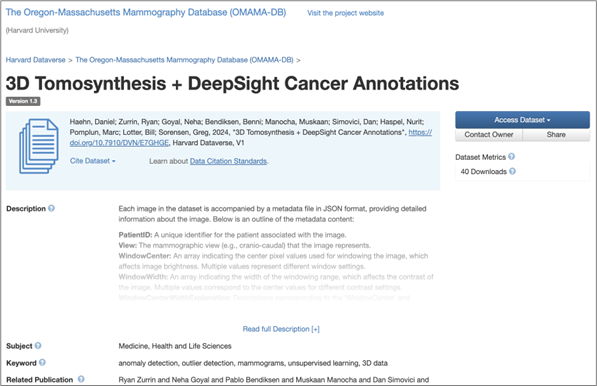
](https://doi.org/10.7910/DVN/E7GHGE)*Large Data Support*[ 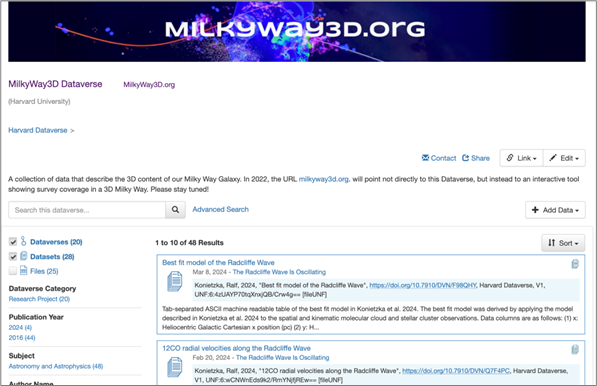
](https://dataverse.harvard.edu/dataverse/MilkyWay3D)*Center for Astrophysics*[ 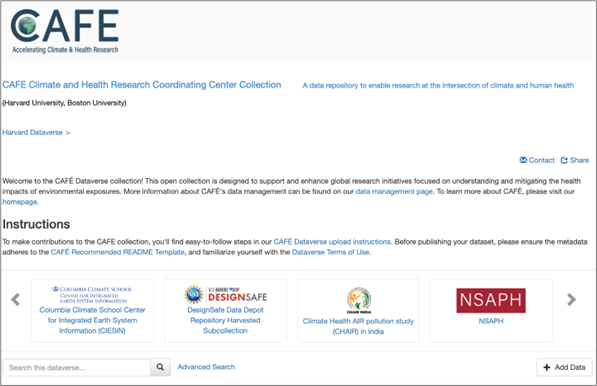
](https://dataverse.harvard.edu/dataverse/cafe)*Harvard Collaborations*
#### Does the repository support the sharing of sensitive data?
The repository supports *anonymized sensitive data, levels 1-2*, as per the guidelines on the [Harvard University Risk Classification](https://privsec.harvard.edu/sites/g/files/omnuum12036/files/2026-01/Reference%20Guide%20-%20PrivSec%20Risk%20Classifications_2025.pdf) website. The best way to share anonymized sensitive data is to use the “[Managed Access](https://guides.dataverse.org/en/latest/user/dataset-management.html#restricted-files-terms-of-access)” workflow on the repository and include a “Data Use Agreement” as best practice. If you have additional questions about sharing sensitive variables in your research data, consult with the [Harvard IRB office](https://cuhs.harvard.edu/find-your-departments-irb-contact-person) before sharing data.
Sort[ 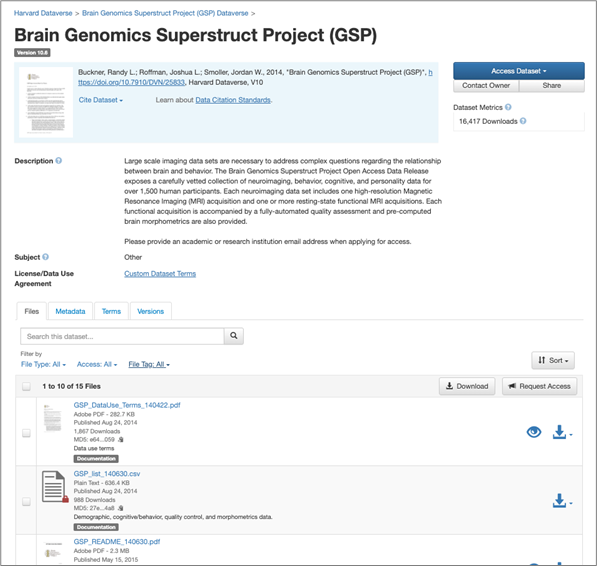
](https://doi.org/10.7910/DVN/25833) 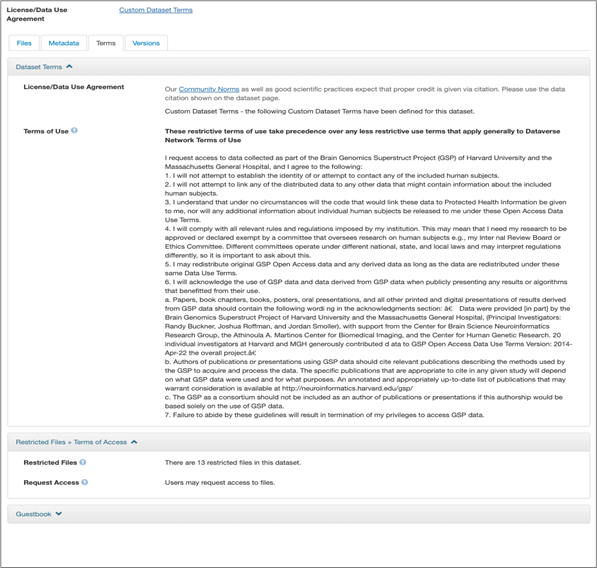
#### Do you have publications related to data shared on the Harvard Repository?
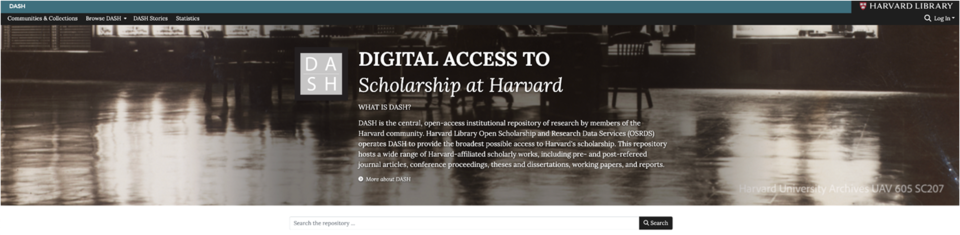
Harvard affiliates should share their publications and other scholarly outputs through [DASH](https://dash.harvard.edu/), Harvard’s central open-access institutional repository for research by members of the Harvard community. DASH is operated by [Harvard Library Open Scholarship and Research Data Services](https://osrds.library.harvard.edu/) (OSRDS), which aims to provide the broadest possible access to Harvard’s scholarship. To enhance discoverability, records in DASH are linked to related research data housed in the Harvard repository. DASH hosts a wide variety of Harvard-affiliated scholarly works, including preprints and post-prints of journal articles, conference proceedings, theses and dissertations, working papers, and reports.
[ 
](https://dash.harvard.edu/)Contact [support@dataverse.harvard.edu](mailto:support@dataverse.harvard) with any questions or to join our weekly virtual office hours on Wednesdays from 11:00 AM to 1:00 PM ET (RSVP required).
*Last updated: November 24, 2025*